Wildfires and Climate Change

Wildfires are becoming more frequent and severe as climate change drives hotter, drier conditions across the United States. Climate‑driven drought, extreme heat, and drying vegetation have lengthened fire seasons and increased the rate of fire spread. As a result, more regions are experiencing heightened fire risk, greater exposure to smoke, and growing threats to people, property, and natural systems.

Historical Conditions and Future Projections for Wildfire

Climate change has been a key factor in increasing wildfire risk and extent in the United States. Wildfire risk depends on multiple factors, including temperature, soil moisture, and the presence of trees, shrubs, and other potential fuels, all of which are closely linked to climate variability and climate change. Climate change-driven droughts and extreme heat events increase the drying of organic matter in forests, the material that burns and spreads wildfire. Compared with 35 years ago, fire seasons are a month longer in parts of the United States, starting earlier and ending later. Additionally, between 2001 and 2020, the average peak wildfire growth rate in the United States nearly doubled.

Models project climate change is likely to lead to warmer, drier conditions, especially in the Southeastern and Western U.S. For much of the U.S. West, projections show that an average annual 1 degree C temperature increase would increase the median burned area per year as much as 600 percent in some types of forests. In the Southeastern United States, modeling suggests increased fire risk and a longer fire season, with at least a 30 percent increase in the area burned by lightning-ignited wildfire by 2060.

Once a fire starts, warmer temperatures and drier conditions can help fires spread and make them harder to put out. Warmer, drier conditions also contribute to the spread of the mountain pine beetle and other insects that can weaken or kill trees, building up forest fuels.

Human-driven factors like land use, forest management, and infrastructure also affect wildfire risk. In the United States, more than 80 percent of wildfires are caused by people. Changes in climate add to these factors and are expected to continue to increase the area affected by wildfires in the United States.
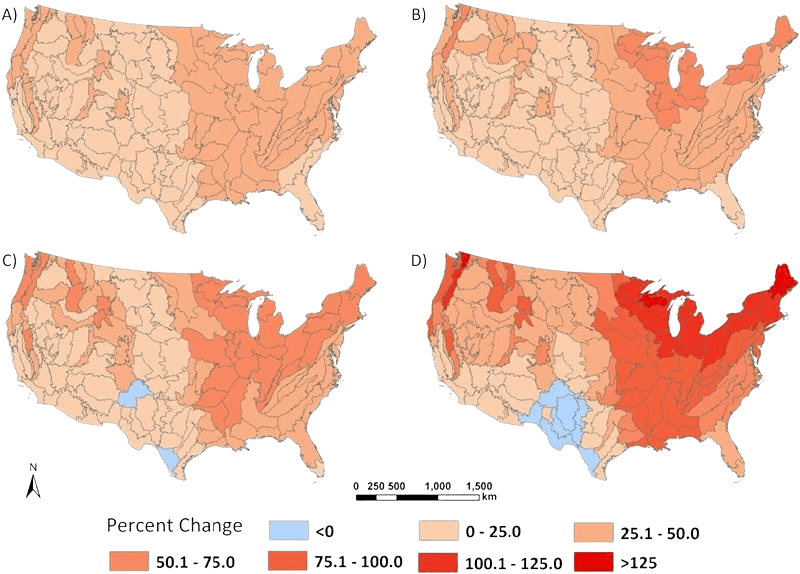
Projected percentage change in annual fire probability across time periods and emission scenarios

Impacts of Wildfires

Wildfires intensified by climate change pose significant public health risks, as smoke reduces air quality, worsens respiratory and cardiovascular conditions, and can contaminate water systems. These impacts extend far beyond burn zones because smoke can travel long distances. Wildfires also force many residents to evacuate or lose their homes entirely, leading to community displacement and long‑term recovery challenges.

They also create significant economic and environmental impacts, with several U.S. fires causing over a billion dollars in damages and recent disasters demonstrating large‑scale property losses and economic disruption. Increasing fire frequency and severity strain ecosystems and release greenhouse gases that forests may struggle to reabsorb.

Public Safety and Health Impacts

Wildfires pose severe public safety concerns, resulting in devastating loss of life and injury. Recent fires have had astonishingly high fatality rates. The August 2023 fires that destroyed the town of Lahaina on Maui, Hawai’i, were the deadliest in the United States in over a century, resulting in over 100 deaths. The January 2025 fires in Los Angeles—the Eaton Fire and Palisades Fire—have a combined fatality total of 31 people. However, a recent research article suggests that over 400 deaths could be linked to the fires.

Beyond immediate safety risks, wildfires can lead to long-term physical and mental health impacts. Many people who survive a wildfire experience significant trauma-related impacts, in addition to navigating loss of housing, financial stability, and community. The Lahaina fires, which destroyed over 2,200 structures, left an estimated 6,000 people homeless.

Furthermore, wildfire smoke and impacts on infrastructure can result in lingering public health threats that extend beyond the area directly affected. Smoke reduces air quality and can cause eye and respiratory illness, especially among children, older adults, people with respiratory and cardiovascular illnesses, and outdoor workers. Wildfires that burn in residential areas can melt plastic water pipes and contaminate water systems with known carcinogens.

Spotlight on Wildfire Smoke

The aspect of wildfire smoke that poses the most significant health risk is particulate matter (PM2.5 ). Exposure to PM2.5  can exacerbate asthma and other health conditions, can impact brain function, and can cause medical complications in pregnant people. These hazards are not confined to the outdoors; wildfire smoke can enter homes and pose health risks to residents. Because smoke can travel great distances on wind currents, these impacts not only affect communities near wildfires, but also communities far away. For example, in 2025, smoke from Canadian wildfires reached the Eastern U.S. and the Midwest.

As part of the South-Central Puget Sound Climate Resilient Communities Accelerator, C2ES convened stakeholders to collaboratively identify solutions to address the combined impacts of heat and smoke in the region. Participants proposed strategies such as investing in resilience hubs and creating a workforce development program for HVAC technicians with specific training on combined AC smoke ventilation systems. These strategies, which have a wide range of co-benefits, can have a far-reaching impact while maximizing limited resources for resilience work.

Economic Impacts

Since 1980, 24 wildfires in the United States have caused at least $ 1 billion in economic impacts each, totaling over $213.5 billion in total costs. These costs are largely from property loss and damage, and from firefighting. For example, the 2023 wildfires on Maui cost the community an estimated $5.7 billion, in addition to destroying thousands of homes, businesses, and vehicles. The January 2025 wildfires in Los Angeles resulted in estimated property losses of between Total wage losses associated with the Los Angeles fires are estimated at , and UCLA’s Anderson School of Management reported a 0.48% decrease in local GDP in 2025 following the fires.

As of 2024, fire suppression cost the U.S. Forest Service and the Department of the Interior per year over the previous decade. Researchers estimate that by 2050, under a middle-of-the-road climate change scenario, costs associated with fire suppression could increase by 42% to $3.9 billion.

Ecosystem Impacts

Wildfires are a natural part of many ecosystems. Although wildfires release carbon dioxide, the plants that recolonize burned areas remove carbon from the atmosphere, generally leading to a net neutral effect on climate over the long term. However, when fires burn more frequently and consume larger areas, as is the case under climate change, the greenhouse gases they release may not be fully removed from the atmosphere if plants cannot reach maturity before burning, or if the plants that recolonize are less efficient at carbon uptake. Wildfires also release greenhouse gases, such as methane, that plants cannot sequester.

How to Build Resilience to Wildfire

Our publication, “Resilience Strategies for Wildfire”, lays out strategies that communities, builders, homeowners, and forest managers can use to reduce the likelihood and impacts of wildfires, such as:

  • Discouraging developments (especially residential) near fire-prone forests through smart zoning rules.
  • Creating defensible space by increasing the distance between structures and surrounding vegetation and clearing brush and other fuels between neighboring homes.
  • Incorporating fire-resistant design features and materials in buildings.
  • Respecting tribal sovereignty by supporting Indigenous fire management practices, including cultural burning techniques that reduce fuel loads and improve ecosystem resilience.
  • Increasing resources allocated to firefighting and fire prevention.
  • Removing fuels, such as dead trees, from forests that are at risk.
  • Developing recovery plans before a fire hits and implementing plans quickly after a fire to reduce erosion, limit flooding, and minimize habitat damage.

We also explore opportunities for federal policy to address wildfire impacts in our blog article “Building Resilience as Wildfires Worsen: Five Federal Policy Goals,” where we discuss learnings from on-the-ground engagement through the Climate Resilient Communities Accelerator in Colorado’s North Front Range.

Other Tools and Resources

The Climate Mapping for Resilience and Adaptation portal helps communities understand and plan for their climate risks today and in the future, including a real-time map of wildfire, drought, flooding, and extreme heat across the United States.

Learn more about resilience through our Climate Resilience Portal.